How Sanju Samson Learned to Speak Hindi — And How You Can Too
Published on 18 March 2026
Inspired by: IPL 2026: Why Sanju Samson's Hindi, Punjabi, Tamil is fluent
This isn't the first time a South Indian cricketer's Hindi has made headlines. When Ravichandran Ashwin spoke fluent Hindi in interviews, it trended. People were surprised. Now Sanju Samson has opened up about how speaking Hindi helped him bond with everyone in the team — not perform better, not communicate tactically. Bond. There's a reason this keeps coming up.
Language isn't just utility. For non-native Hindi speakers moving to a new city or joining a new team, it's belonging.
What Sanju Samson Actually Said
Sanju Samson, a Keralite, recently said that learning to speak Hindi helped him connect with his teammates at a deeper level. In a team like the Indian cricket squad — players from Tamil Nadu, Kerala, Bengal, Punjab, Maharashtra — Hindi is the common thread. It's not the mother tongue of most players. But it's the bridge.
That's the real insight. Hindi isn't about being North Indian. It's about not being the outsider in the room.
The Problem Nobody Talks About
Here's something that surprises most people: you can know Hindi and still not be able to speak it.
Millions of Indians have studied Hindi in school for years. They can read the Devanagari script. They can write grammatically correct sentences. And then they land in Delhi, Mumbai, or a Hindi-speaking office — and freeze.
Why?
Because spoken Hindi is a different language from written Hindi.
The "Vah" vs "Vo" Trap
In formal written Hindi, the third-person singular pronoun is vah. That's what your textbook says. That's what you memorised.
But in every real conversation you will ever have, people say vo. Nobody says vah unless they're reciting a poem.
This gap — between what you learned and what people actually say — is what makes non-native speakers feel like they're starting from zero even after years of study.
Why Most Learning Materials Don't Fix This
Duolingo, school textbooks, YouTube videos — most of them teach Hindi through the script and through formal grammar. They're useful for reading. They're not built for speaking.
The issue isn't that those tools are bad. It's that they're solving a different problem. If your goal is to pass an exam or read a newspaper, they work. If your goal is to bond with people the way Sanju Samson did — to hold a real conversation without freezing — they leave a gap.
That gap is exactly what we built Speak Hindi Fast to close.
The Formula Method — Why It Works
Most learners get stuck on grammar. Specifically, they get confused between tenses that feel almost identical — like present tense and present continuous.
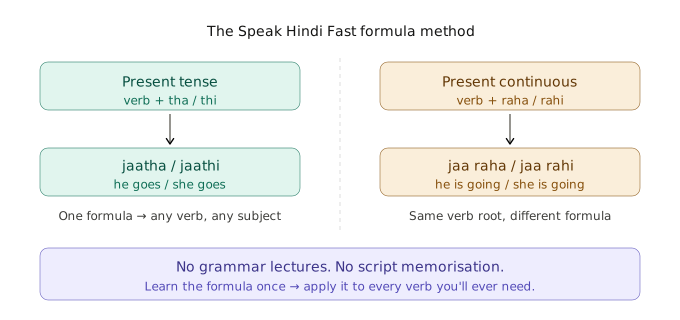
Instead of grammar lectures, we use formulas. Clean, simple, memorable.
Present tense → verb + tha
Jaatha → goes
Present continuous → verb + raha
Jaa raha → going
One formula. Applied once. You now know how to build both tenses for any verb. No lecture. No memorisation of exceptions before you've even used the base form.
This is taught entirely in English. No Devanagari script. No transliteration drills. Just the formula, applied to real words you'll actually use.
What You'll Learn in Lesson 2 (In 3 Minutes)
In Lesson 2, you'll learn 10 essential Hindi verbs — in English, using the formula method — in under 3 minutes.
Not 10 vocabulary flashcards. 10 verbs you can immediately plug into the tense formulas and start forming real sentences.
Speak Hindi Fast teaches spoken Hindi in English using a formula method — no script, no grammar overload, fully self-paced.
Ready to Speak Hindi Fluently?
Join 5,300+ learners who have mastered spoken Hindi without the headache of grammar overload.
Start My 30-Day Journey